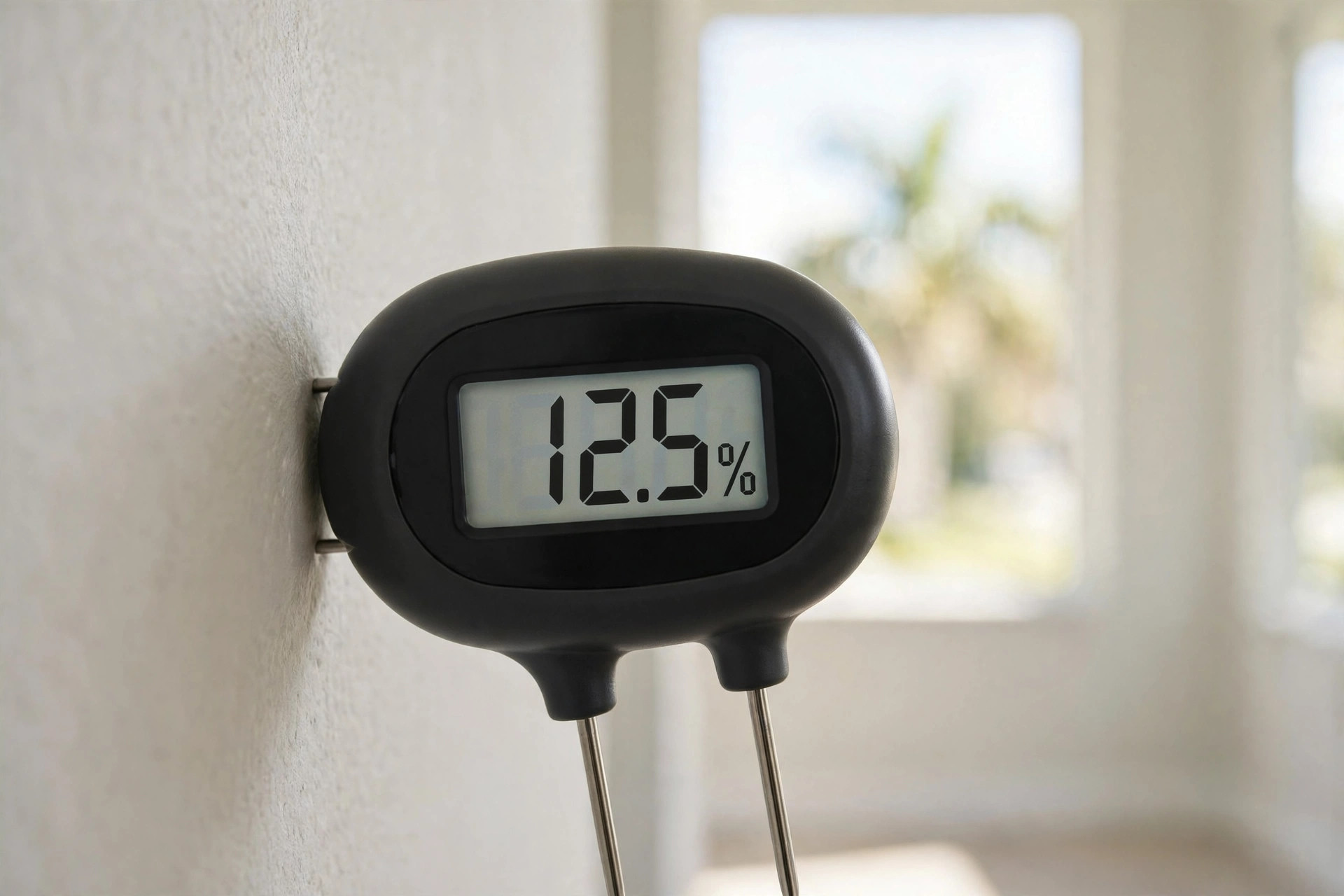
In Florida, moisture is the story of almost every house. Humidity hangs in the air ten months of the year, afternoon storms drive rain sideways, and a stain on a ceiling could be a 2012 event or a leak that started last week. A moisture meter is the cheapest tool that answers that question — and for a buyer deciding which house gets the offer, it may be the most valuable tool on this entire site. This guide compares the five meter types worth owning in 2026, explains how to read them without fooling yourself, and ends with the one verdict that matters.
Last updated: October 7, 2026 · Prices and availability checked October 2026.
Florida Homebuyer HQ is reader-supported. When you buy through links on our site, we may earn an affiliate commission.
Compare the picks
| Product | Best for | Key spec | Price |
|---|---|---|---|
| Pin + pinless combo moisture meter | Most Florida buyers | Pin + pinless modes; material modes (wood, drywall, masonry) | Check price → |
| Pin-type moisture meter | First-time buyers on a budget | Calibrated percentage readings; pocketable | Check price → |
| Pinless moisture meter | Damage-free scanning at showings | Scans up to ~1 in. deep; relative readings | Check price → |
| Digital thermo-hygrometer | Humidity context for every reading | Measures air RH; min/max logging | Check price → |
| Moisture meter with deep-wall probes | Known past leaks, patched drywall | Long probes reach behind trim, into cavities | Check price → |
Why moisture meters matter more in Florida than anywhere else
Florida homes fail from the outside in and the bottom up. Roofs take direct sun and sideways rain. Slab foundations wick moisture. Air conditioning runs nearly year-round, and the temperature difference between a cold interior and a hot exterior turns exterior walls into condensation surfaces. Buyers in drier states worry about roofs; Florida buyers worry about moisture everywhere — and most of it hides behind paint.
A moisture meter does not replace the inspector. What it does is turn "that stain looks suspicious" into a number you can compare against the wall next to it. A ceiling stain that reads the same as the surrounding dry ceiling is almost certainly an old event. A stain that reads dramatically higher is active, and an active leak in Florida is never just a leak — it is mold habitat, insurance questions, and remediation money. Knowing which one you are looking at before the inspection period is exactly the kind of decision a thirty-dollar tool should help you make.
Pin vs. pinless vs. combo: the three types, honestly compared
Pin-type meters press two metal pins into the surface and measure electrical resistance between them — wetter material conducts better. They read the exact spot they touch, work through paint, and are the cheapest option. Downsides: they leave tiny pin holes in drywall (always ask the listing agent before testing at a showing), and they only measure the surface layer the pins reach — about half an inch deep.
Pinless meters use electromagnetic waves to scan beneath the surface without touching — you press a flat pad against the wall and read a relative value. No holes, faster to use across large areas, and they see deeper (typically up to an inch). Downsides: they cost more, they are more sensitive to material density and embedded metal, and the reading is relative rather than a calibrated percentage — you compare areas rather than reading absolute values.
Combo meters carry both sensors in one body. Scan pinless across a wall to find anomalies, then switch to pin mode to confirm at the exact spot. This is the most capable option for a buyer, and in 2026 the price gap between a good combo meter and a single-mode one has narrowed enough that most Florida buyers should start here.
There are also thermo-hygrometers (which measure air humidity rather than material moisture) and deep-wall probes (long pins for reaching through baseboards into wall cavities). Neither replaces a meter, but both earn a place in the kit for specific jobs — humidity context and probing around suspected plumbing leaks.
How we compared them
We compared meter categories across the specs that matter to a buyer, not a contractor: measurement range and resolution, whether the reading is a calibrated percentage or a relative scale, scan depth, material mode settings, display readability, battery type, and build quality for the price. We weighted ease of use heavily — a tool you reach for at a showing is worth ten tools that stay in the drawer — and we paid special attention to how each type behaves in Florida's high ambient humidity, where background moisture levels run higher than the manuals assume.
An honest note: we did not buy and lab-test every meter on the market. These are researched roundups built from manufacturer specifications, published accuracy data, professional-inspector buying guides, and aggregated owner reviews. Every claim below is about what a category of meter does and how to use it — not a promise that we personally tested your exact unit.
The five moisture meters worth owning in 2026
Pin + pinless combo moisture meter Best overall
The best all-around pick for a Florida buyer. Scan pinless across baseboards, window sills, and ceiling stains to find anomalies fast, then confirm with pin mode at the exact spot. Combo meters eliminate the biggest weakness of each single mode: pinless-only meters can be fooled by dense material, and pin-only meters miss moisture sitting deeper than the pins reach. Having both in one body means you stop second-guessing the reading.
Look for a combo with separate material modes (wood, drywall, masonry), a backlit display you can read in a dim attic, and an audible tone that rises with moisture — the tone lets you scan a whole wall without staring at the screen. This is the meter most home inspectors carry, which tells you something.
- both sensing modes in one tool; scan-then-confirm workflow; material modes reduce false readings
- audible tone speeds up wall scanning; backlit display for attics and crawlspaces
- costs more than single-mode meters; pin mode still leaves small holes in drywall
- more settings to learn — skim the manual before the first showing
Best for: Florida buyers who want one meter that scans fast and confirms precisely — the all-around pick. Not ideal for: buyers who only need the cheapest single reading; it costs more and has more settings to learn.
 LASELION 2-in-1 Pin & Pinless Moisture Meter MS03 –Check price on Amazon →
Pin-type moisture meter (budget pick) Best budget
The simplest, cheapest way into moisture testing — and honestly, the right first tool for most buyers. Press the pins into a baseboard near a plumbing wall, read the number, press into the same material six feet away, and compare. The whole technique takes five minutes to learn. Budget pin meters typically cover wood and drywall with a single scale, which is all a buyer needs.
The limitation is etiquette, not technology: pins leave small holes. At a showing, ask the listing agent before probing painted drywall — most will say yes, but asking keeps everything comfortable. Use pinless scanning or the trim edges for areas where you do not want to mark the surface.
- lowest cost of any useful meter; calibrated percentage readings; simple to learn
- precise spot readings through paint; tiny and pocketable
- leaves pin holes — ask before testing at showings
- measures only the surface layer; slower to scan large areas than pinless
Best for: buyers who want the simplest, cheapest honest reading — press, read, compare. Not ideal for: fast scanning of large areas, or testing surfaces where pin holes aren’t allowed.
 General Tools MMD4E Moisture Meter for Wood, Walls & WaterCheck price on Amazon →
Pinless moisture meter (no holes) Best for showings
The showing-friendly option. Press the flat sensor pad against the wall and glide it across ceilings, baseboards, and around windows — no holes, no asking permission, and fast enough to scan a whole room in minutes. Pinless meters read deeper than pins (often up to an inch), which helps with tile floors, stucco exteriors, and anywhere you want a reading without marking the surface.
The trade-off is that readings are relative: you compare one area against another rather than reading an absolute percentage. In Florida that is usually fine — you are hunting for differences, not calibrating a lab report. Watch out for embedded metal: nail plates, corner bead, and plumbing straps read as "wet" on pinless meters, so confirm anything suspicious with a second method.
- zero surface damage — ideal at showings and open houses; fast area scanning
- reads deeper than pin meters; good on tile, stucco, and finished surfaces
- relative readings need comparison areas; embedded metal creates false positives
- denser materials need the right mode or readings skew
Best for: showings and open houses where you can’t mark the surface — fast, hole-free scanning. Not ideal for: buyers who want absolute calibrated percentages; these readings are comparative.
 Klein Tools ET140 Pinless Moisture Meter, Detects up toCheck price on Amazon →
Digital thermo-hygrometer (humidity context) Best companion tool
Not a moisture meter at all — it measures the air, not the wall — but it earns its place because Florida humidity warps every other reading you take. A house showing 68% indoor relative humidity at the showing will make every material read slightly higher; knowing the ambient conditions keeps you from overreacting to elevated numbers. Hygrometers are also how you check whether the AC is actually dehumidifying: readings that stay above 60% with the system running deserve a question for the inspector.
These are cheap, pocketable, and useful after you buy too — leave one in the garage or attic access to track humidity seasonally. Buy one that logs minimum and maximum values so a single visit tells you the range, not just the moment.
- explains high material readings; checks whether the AC dehumidifies properly
- very cheap; min/max logging turns one visit into a data point
- measures air, not materials — it is context, not a diagnosis
- slow to stabilize — give it several minutes in each location
Best for: any buyer who wants to stop Florida humidity from warping their moisture numbers. Not ideal for: measuring moisture in materials — it reads the air, not the wall.
 TempPro TP50 Digital Hygrometer Indoor Thermometer RoomCheck price on Amazon →
Moisture meter with deep-wall probes Best for suspected leaks
For the serious case: long, slim probes that reach behind baseboards and into wall cavities near suspected plumbing leaks. Most buyers never need this — the standard meter covers 90% of showing situations. But if you are evaluating a house with a known past leak, a suspiciously fresh patch of drywall, or a bathroom renovation of unknown quality, deep probes let you test where the problem actually lives instead of where the surface looks fine.
This is a supplement to a combo meter, not a replacement, and it is firmly a second-tool purchase. Buy it when you have a specific house with a specific suspicion — or skip it and let the inspector's equipment handle the deep work.
- reaches behind trim and into cavities where surface meters cannot
- best tool for verifying a repaired leak actually stayed repaired
- overkill for routine showings; probes are more invasive
- adds cost for a tool most buyers use once — borrow or skip it
Best for: buyers evaluating a house with a known past leak or a suspiciously fresh drywall patch. Not ideal for: routine showings — overkill for 90% of situations; let the inspector handle the deep work.
General Tools MMD4E Moisture Meter for Wood, Walls & WaterCheck price on Amazon →
Our verdict
For most Florida buyers, the answer is simple: buy a pin + pinless combo meter. It is the tool inspectors carry, it handles both the fast showing scan and the careful confirmation, and the price premium over a single-mode meter has shrunk to the point where the convenience alone justifies it. If the budget is tight, a basic pin-type meter does the core job — compare, compare, compare — for the price of a pizza.
Add a digital hygrometer to the kit regardless of which meter you choose. Florida's ambient humidity is the single biggest source of misread moisture numbers, and a five-minute humidity check is the difference between a confident reading and a guess. The deep-wall probes can wait until you have a house that needs them.
How to read the numbers without fooling yourself
Three rules, and the whole technique is in them. Rule one: compare, never absolutes. Test the suspicious spot, then test the same material a few feet away, then test a known-dry area. You are hunting for differences of several percentage points or more — not memorizing what "17%" means on its own.
Rule two: same material, same conditions. Drywall and baseboard wood read differently by design. Paint, texture, and temperature shift readings. Compare drywall to drywall, wood to wood, and take your comparison reading within a minute of the suspect reading.
Rule three: moisture is a question, not a verdict. An elevated reading means "ask the inspector to look here" — it does not mean the house has a leak, and it certainly does not mean it has mold. Meters find moisture; mold assessment is a separate specialty. The value of the tool is directing professional attention, not replacing it.
Frequently asked questions
Can a moisture meter detect mold?
No. It detects moisture, which is a condition mold needs — not mold itself. Elevated readings mean "investigate further," and mold assessment is a separate specialty with its own testing.
What reading counts as "wet" in a Florida house?
There is no universal number — it depends on the material, the meter, and ambient humidity. That is why comparison is the technique: the stain reads 28% while the surrounding ceiling reads 9%, and the difference is the finding, not the 28% itself.
Will pin holes in drywall upset sellers?
Two-millimeter pin holes are trivial to fill, but always ask the listing agent before testing at a showing. At your own inspection, with the seller's permission for the inspection, broader testing is expected.
Do I still need a professional inspection if my readings look clean?
Absolutely. Your meter screens the surfaces you can reach; the inspector evaluates systems, safety, and patterns you are not trained to see — plus they carry professional-grade equipment. Never waive the inspection because your own checks looked clean.