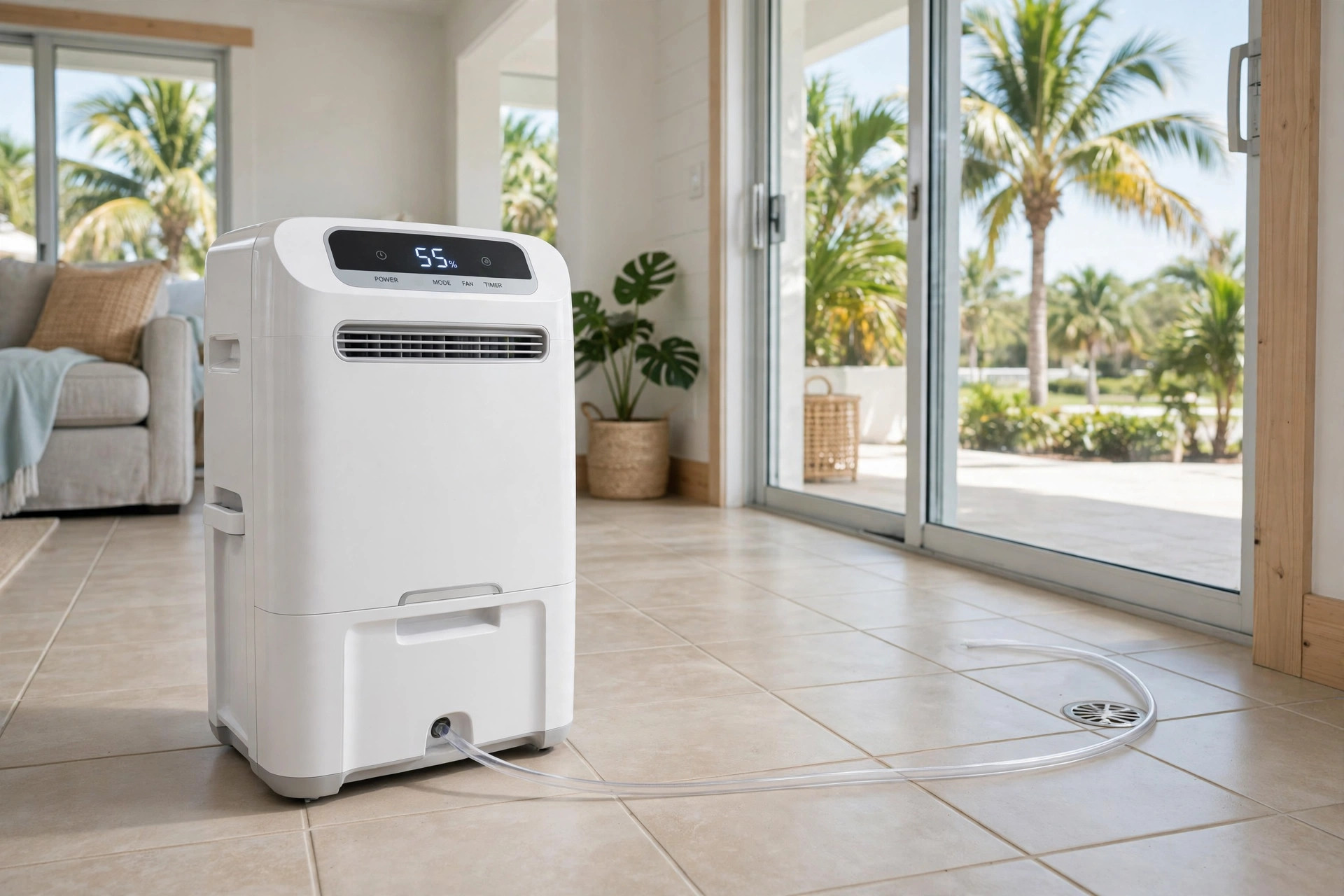
Florida indoor air wants to sit at 65–75% humidity for much of the year, and mold is happy anywhere above about 60%. Your air conditioner dehumidifies only while it cools — which leaves the muggy, mild days, the rainy weeks, and every closed-up second home exposed. A dehumidifier sized and drained correctly holds a home at the 45–50% that keeps mold dormant, wood stable, and indoor air feeling cooler than the thermostat says. This guide sizes the five classes worth buying in 2026 with honest coverage math, explains the one feature (a pump) that decides whether a unit actually runs unattended, and starts — as every Florida moisture question should — with finding the water source first.
Last updated: October 20, 2026 · Prices and availability checked October 2026.
Florida Homebuyer HQ is reader-supported. When you buy through links on our site, we may earn an affiliate commission.
Compare the picks
| Product | Best for | Key spec | Price |
|---|---|---|---|
| 50-pint dehumidifier with built-in pump (Energy Star) | Most Florida single-family homes | 50 pints/day (2019 DOE) · built-in pump · Energy Star | Check price → |
| 35-pint dehumidifier with pump or gravity drain | Condos, townhomes & smaller homes | 35 pints/day · compact body · pump on many models | Check price → |
| High-capacity crawl-space / whole-house dehumidifier (70+ pint commercial class) | Large homes, garages & crawl spaces | 70–90+ pints/day · ductable · built for continuous duty | Check price → |
| Small dehumidifier for closets, bathrooms & laundry rooms | Closets, bathrooms & laundry rooms | Pint-or-less daily · desiccant or compact compressor · near-silent options | Check price → |
| Smart Wi-Fi dehumidifier with humidity alerts | Second homes & snowbird properties | App monitoring + alerts · pump models available · schedules | Check price → |
First: a dehumidifier is not a leak repair
Before sizing anything, walk the house with fresh eyes. A dehumidifier manages airborne moisture from Florida being Florida — showers, cooking, infiltration, slab and crawl-space vapor. It does not fix a leaking supply line, a failed shower pan, AC condensate backing up, or grading that pours rain against the foundation, and running one against an active leak just hides the damage longer. If one room or one wall reads far wetter than the rest, start with our moisture meters guide and find the source. Source fixed (or ruled out), the sizing below will treat you well.
Size by pints — and read the pint rating correctly
Capacity is rated in pints of water removed per day. One trap: the test standard changed in 2019, so today's "50-pint" unit is yesterday's roughly 70-pint unit — compare only current-standard numbers, and be suspicious of listings still advertising the old inflated figure. As working guidance for Florida conditions: a 35-pint class unit suits a condo or up to roughly 1,000–1,500 sq ft of moderately damp space; the 50-pint class covers most single-story homes' main living zones or a very damp smaller home; beyond that — large homes, wet crawl spaces, whole-structure control — you are in the commercial class below. When between sizes in Florida, size up: an oversized unit short-cycles to the setpoint and rests; an undersized one runs flat-out forever and still loses in August.
The pump is the feature that matters most
A portable dehumidifier with a full bucket is a decoration. In peak humidity a 50-pint unit can fill its bucket in well under a day, which makes drainage — not capacity — the real-world spec. Best is a continuous gravity drain to a floor drain or sink (free, silent, nothing to fail). Next is a built-in pump, which lifts water up to a sink or out a window and is the only option in rooms with no drain at floor level. Bucket-only operation is acceptable solely in a space you walk past daily — a laundry room, never a second home. Every pick below is chosen with a drain or pump path in mind.
How we compared them
We compared dehumidifier classes on current-standard pint capacity, Energy Star efficiency (these run for thousands of hours — efficiency is a real operating cost), drainage options, humidistat accuracy and range, and noise — weighted toward Florida use: year-round duty, shoulder-season humidity, closed-up homes, and closets. An honest note: these are researched roundups built from manufacturer specifications and aggregated owner reviews, not hygrometer testing of every unit in a lab. Humidity targets are the widely used 45–50% indoor guidance; homes with health concerns should follow their clinician's and an indoor-air professional's advice.
The five dehumidifiers worth buying in 2026
50-pint dehumidifier with built-in pump (Energy Star) Best overall
The default recommendation for a Florida house: a 50-pint (under the current DOE test standard) Energy Star unit with a built-in condensate pump. In Florida's climate a dehumidifier is not a basement appliance you run in August — it is a year-round partner to your air conditioning, holding indoor humidity at 45–50% on the muggy shoulder-season days when the AC barely runs but the air stays wet. The built-in pump is the feature that makes that realistic: it pushes condensate up to a sink, a drain, or out through a window, so the unit never shuts off on a full bucket while you are at work or away for the weekend.
Placement decides how much of the house it covers: central hallway or the largest open living space, doors open, a few inches of clearance around the intake. One 50-pint unit will not dehumidify a closed-off 2,800 sq ft two-story house by itself — see the whole-house pick below — but for most one-story Florida homes and open-plan main levels, this class is the workhorse. Set the humidistat to 45–50% and let it work; below about 40% you are paying to make the air uncomfortably dry for no mold benefit.
- Pump drainage means it never stops on a full bucket; holds 45–50% rh on the humid days ac alone cannot handle
- One unit cannot cover a large closed-off floor plan; adds modest heat and noise to the room it runs in
Best for: Most Florida single-family homes — pump drainage means it never stops on a full bucket. Not ideal for: households whose needs are the opposite end of the size range.
35-pint dehumidifier with pump or gravity drain Best for condos
Condos, townhomes, and smaller single-story homes do not need the big unit — they need the right-sized one, placed well. A 35-pint class machine covers roughly a typical condo or the main living zone of a smaller home, runs quieter and cheaper than its 50-pint sibling, and rolls through standard doorways when you want to move it between a damp bathroom wing and the living area.
Condo-specific homework applies: check your association's rules and your floor's tolerance for a gravity drain hose before relying on one — a pump model that lifts water to a kitchen or laundry sink sidesteps most of it. Florida condo owners dealing with the post-storm, AC-off days will also find this class is the largest that still makes sense on a portable power station budget in an outage rotation — dehumidifying in shifts between fridge cycles is a real hurricane-season tactic.
- Right-sized and quieter for condos and smaller homes; easier to move room to room on its casters
- Undersized for large or very damp single-family homes; bucket fills fast in peak humidity without a drain or pump
Best for: Condos, townhomes & smaller homes — right-sized and quieter for condos and smaller homes. Not ideal for: households whose needs are the opposite end of the size range.
High-capacity crawl-space / whole-house dehumidifier (70+ pint commercial class) Best whole-house
Some Florida moisture problems are bigger than a portable appliance: a 2,500+ sq ft house that never drops below 60% indoors, a garage workshop where tools rust, or a crawl space / enclosed foundation that feeds musty air into the home. Commercial-class dehumidifiers — the Santa Fe and AlorAir type — are built for exactly this: far higher daily capacity, metal cabinets, ducting options to distribute dry air, and duty cycles measured in years of continuous running rather than seasons.
Be clear-eyed about what you are buying into: this is a semi-permanent installation (floor or hung placement, a real drain line, sometimes a dedicated outlet), at a price several times the portable picks, and it rewards a plan — ideally sized with the same moisture-first thinking as our moisture meters guide: find where the water is coming from before you buy machinery to remove it. A crawl-space unit fighting an unsealed dirt floor or a plumbing leak is an expensive bandage. Fix sources first, then let this class keep the whole structure dry.
- Capacity and durability no portable unit matches; ductable — dries the whole structure, not one room
- Highest cost here, plus installation and a real drain line; overkill — and wasted money — if the moisture source is a fixable leak
Best for: Large homes, garages & crawl spaces — capacity and durability no portable unit matches. Not ideal for: households whose needs are the opposite end of the size range.
Small dehumidifier for closets, bathrooms & laundry rooms Best for small spaces
The musty Florida closet — leather shoes filming over, linens smelling swampy by Friday — is a small-space problem with a small-space answer. Compact compressor minis and rechargeable desiccant units will not change a whole home's humidity, and they do not need to: inside a closed closet, a laundry room, or a windowless bathroom, a small unit that holds the micro-climate under 55% stops mold where it actually starts.
Choose by power access: a compact plug-in compressor mini for a bathroom or laundry room with an outlet; a rechargeable desiccant canister (dry it out in its dock or a low oven per instructions) for closets with no outlet at all. Either way, pair it with the habit that makes small-space control work — keep the door closed, and check the space monthly with a cheap hygrometer so you know the unit is keeping up during the wettest weeks.
- Fixes the closet/bathroom micro-climates the big units miss; desiccant options need no outlet and make no noise
- Micro-climates only — no whole-room effect; desiccant canisters need regular recharging in peak season
Best for: Closets, bathrooms & laundry rooms — fixes the closet/bathroom micro-climates the big units miss. Not ideal for: households whose needs are the opposite end of the size range.
Smart Wi-Fi dehumidifier with humidity alerts Best smart pick
Florida has a dehumidifier user no other state has in such numbers: the owner who is not there. A second home or snowbird property sitting closed through a humid summer can grow mold for months before anyone opens the door. A Wi-Fi dehumidifier with app humidity readouts and high-humidity or full-bucket alerts turns that blind spot into a phone notification — and lets you (or a neighbor, or a home-watch service) act before a musty smell becomes a remediation bill.
Two requirements make the smart pick actually smart: a pump or a real drain (an alert that the bucket is full, from a unit that then sits idle for six weeks, is just bad news delivered promptly), and a home Wi-Fi network that stays up while you are away. Set alerts at 55% RH so you get warned while there is still time to react. For the property you live in full-time, the standard 50-pint pick above is the better value — buy smart for absence, not for novelty.
- High-humidity alerts protect an empty home; remote rh history shows whether the ac is keeping up
- Useless if it stops on a full bucket — pump/drain required; app and wi-fi dependency for the core benefit
Best for: Second homes & snowbird properties — high-humidity alerts protect an empty home. Not ideal for: households whose needs are the opposite end of the size range.
Our verdict
Most Florida homeowners should buy the 50-pint Energy Star dehumidifier with a built-in pump, place it centrally with doors open, set it to 45–50%, and connect the drain — that single setup quietly prevents the mold, mustiness, and swollen-door season that Florida houses otherwise accept as normal. Condo owners should take the 35-pint class; owners fighting whole-structure humidity or a wet crawl space should budget for the commercial class after fixing sources; and anyone leaving a Florida home empty for weeks should make it the smart pick with a pump. Add the closet unit where the shoes live, verify with a hygrometer, and check the results against the readings in our home inspection tools guide.
Frequently asked questions
What humidity should a Florida home be kept at?
Aim for 45–50% relative humidity indoors. Sustained readings above about 60% invite mold growth on drywall, closets, and AC ducts; sustained readings below 40% dry out woodwork and sinuses for no benefit. A $15 hygrometer in the main living space tells you more than any guess — check it on a rainy, mild day, when Florida homes run wettest.
Why is my home humid when the AC runs all day?
Common Florida causes: an oversized AC that cools fast and shuts off before it can wring out moisture, a thermostat set very low (cold surfaces condense humid infiltrating air), leaky ductwork in a hot attic pulling in moisture, or simply shoulder-season weather — mild and wet — where the AC barely runs at all. A standalone dehumidifier addresses the last two patterns directly and buys time to fix the first two properly.
Can a dehumidifier replace fixing a damp crawl space?
No. Standing water, an unsealed dirt floor, or plumbing leaks under the house must be corrected first — drainage, a vapor barrier, and repairs. Once the space is sealed and dry-sourced, a commercial-class crawl-space dehumidifier is the standard way to keep it that way. Machinery after source control, never instead of it.
How much does it cost to run one?
An Energy Star 50-pint unit draws roughly 300–600 watts while running and cycles against its humidistat; in Florida duty that commonly works out to a noticeable but modest monthly amount — far less than over-cooling the whole house with AC to chase the same dryness, and trivial next to one mold remediation. Check the unit's energy factor (liters per kWh) when comparing: higher is cheaper dry air.