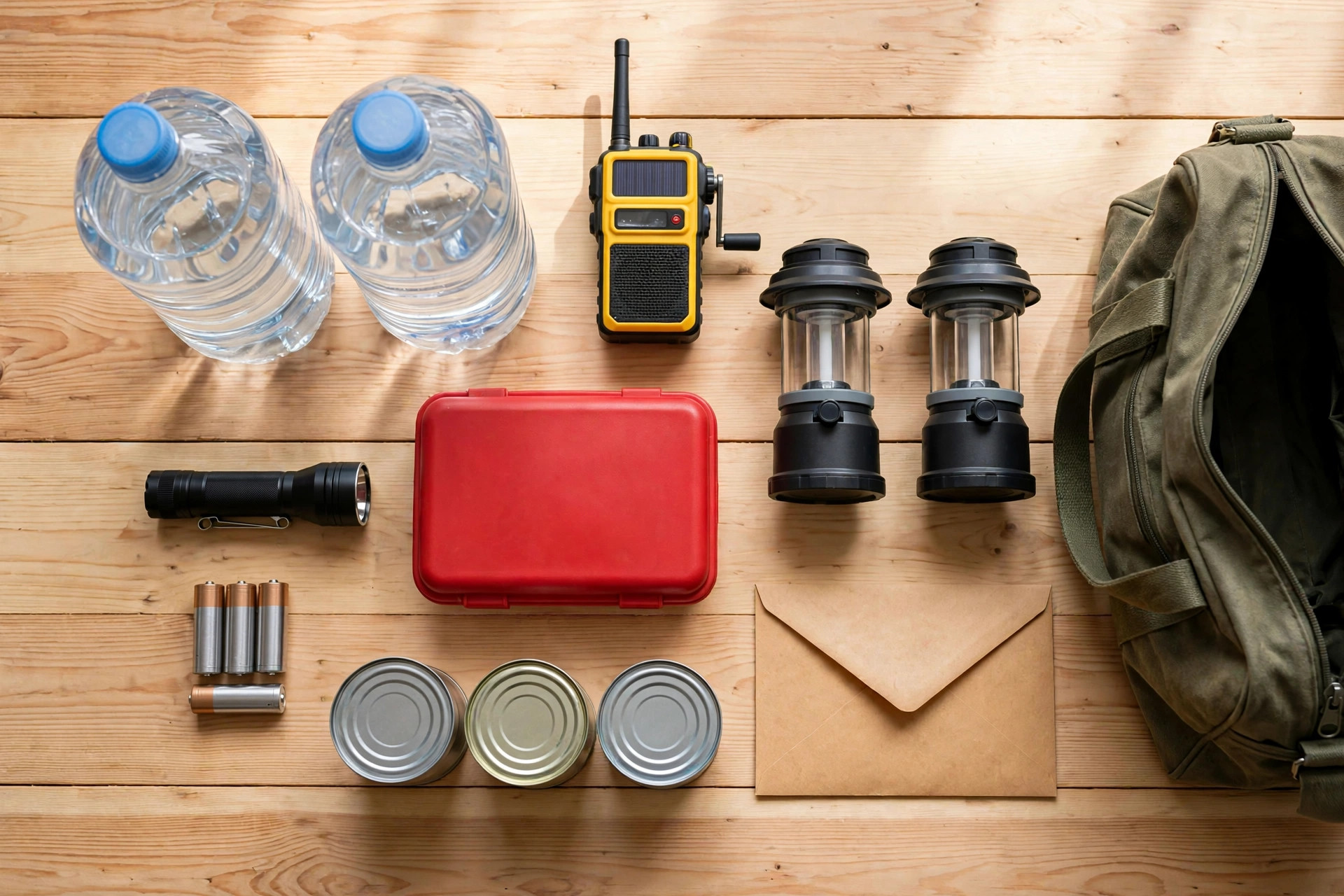
Every new Florida homeowner learns the same lesson, usually in their first August: hurricane season does not care that you just closed. The shelves empty three days before landfall, the gas stations run dry, and the kit you meant to assemble becomes a wish list. A pre-built emergency kit is the fastest way to close that gap — buy it in the calm season, store it in a closet, and spend storm week on shutters and plans instead of supply runs. This guide compares the five kit categories worth buying in 2026, what each one actually covers, and the gaps you will still need to fill yourself.
Last updated: October 7, 2026 · Prices and availability checked October 2026.
Florida Homebuyer HQ is reader-supported. When you buy through links on our site, we may earn an affiliate commission.
Compare the picks
| Product | Best for | Key spec | Price |
|---|---|---|---|
| Complete 2-person 72-hour emergency kit | Couples and single buyers | 72-hour supply for 2 people; 5-category coverage | Check price → |
| Family 4-person survival kit | Households with kids | 72-hour supply for 4 people; split-bag designs | Check price → |
| Portable power station | Multi-day outage comfort | ~500Wh class runs phones, lights, fan for days | Check price → |
| Emergency hand-crank weather radio | Official alerts, any conditions | NOAA bands; hand-crank + solar | Check price → |
| Rechargeable LED lantern set | Safe indoor light for days | Room-filling LED; rechargeable | Check price → |
What a Florida hurricane kit has to cover
Emergency management agencies converge on the same five categories, and every kit below is judged against them. Water: a gallon per person per day for at least three days — and Florida's heat makes this the non-negotiable one. Food: three days of non-perishable food that needs no cooking, since the power will likely be out. Power and light: the grid goes first in a hurricane; flashlights, lanterns, and a way to charge phones decide whether the week after the storm is an inconvenience or a crisis.
Communication: cell networks congest and fail — a NOAA weather radio with battery, hand-crank, or solar power is the official lifeline. Safety and documents: first aid, medications, and copies of insurance policies, IDs, and property records in a waterproof container. If a kit skips one of these five, it is not a hurricane kit — it is a camping bag with delusions.
Pre-built kit vs. building your own
Building your own kit is cheaper per item and lets you match your household exactly — your medications, your pets, your dietary needs. It also takes a full weekend of research and shopping, which is why most people never finish one. A pre-built kit is the opposite trade: you pay a premium for completeness and speed, and you get a kit in a box on Tuesday instead of a project that dies in a spreadsheet.
The honest answer for most new Florida homeowners: buy a pre-built kit for the core, then customize it. The kit covers water, food, first aid, and shelter basics on day one; you add the personal medications, pet supplies, documents, and cash over the following week. A finished-but-imperfect kit beats a perfect kit that does not exist — this is not a category where waiting is virtuous.
How we compared them
We compared kit categories against the five coverage areas above, checking stated person-days of supply, water and food shelf life, the quality of included power and lighting gear, packability and storage size, and how much of the kit would still be usable five years from now. We weighted honest capacity ratings heavily — a kit that claims "4-person, 72-hour" support with twelve granola bars loses to one that shows its math.
An honest note: these are researched roundups built from manufacturer specifications, emergency-preparedness guidance, and aggregated owner reviews — not hands-on survival testing, which would take a hurricane to do properly. Every claim below is about what a category of kit includes and how to judge it, so you can match the kit to your household.
The five hurricane kit options worth buying in 2026
Complete 2-person 72-hour emergency kit Best overall
The default pick for a couple or a single buyer in a new Florida home. A good 2-person kit bundles water pouches, food bars with a multi-year shelf life, a basic first aid kit, emergency blankets, a hand-crank flashlight/radio combo, and a backpack or bucket to hold it all — the full five-category coverage in one purchase. Check the food and water expiration dates on arrival and mark your calendar to rotate them.
The limitation is scale: two people for three days is the floor, not the ceiling, and Florida outages after major storms routinely run longer. Treat this as the foundation and add a separate water supply and a portable power station from the options below.
- all five coverage categories in one box; food and water with long shelf life
- compact and storable — fits in a hall closet; fastest path to "prepared"
- 72 hours is a minimum, not a plan — major-storm outages run longer
- generic food and gear — you will still customize for medications and pets
Best for: a couple or single buyer who wants the full foundation of a kit in one purchase. Not ideal for: households needing more than three days of coverage — Florida outages routinely run longer.
 Ready America 70280 Emergency 2-Person 3-Day SurvivalCheck price on Amazon →
Family 4-person survival kit Best for families
For households with kids, the math changes: more water, more food, and gear sized for people who cannot improvise. Family kits typically double the 2-person supplies and add kid-relevant items — activity books or cards, extra blankets, and more comprehensive first aid. The best ones split supplies across two bags so one person is not carrying the whole household.
Verify the person-count honestly: some "4-person" kits contain barely more than the 2-person version with a bigger bag. Divide the stated food calories and water volume by the person-days claimed — if the math does not reach three days per person, it is marketing, not preparation.
- real capacity for a family; split-bag designs distribute the carry weight
- kid-aware extras reduce the improvisation burden during an outage
- bulkier to store — needs a real closet, not a shelf
- person-count claims vary wildly — check the calorie and water math yourself
Best for: families who need real capacity for four, including kid-aware extras. Not ideal for: small homes with no real closet space — these kits are bulky.
 Ready America 72 Hour Deluxe Emergency Kit, 4-Person 3-DayCheck price on Amazon →
Portable power station Best power upgrade
The single biggest quality-of-life upgrade in a Florida outage. A portable power station — a big lithium battery with AC outlets and USB ports — keeps phones charged, runs a fan through the hot nights, powers a CPAP, and keeps a small fridge cold for the critical first day. No fuel, no fumes, no generator noise, and safe to run indoors, which a gas generator is emphatically not.
Size it to the job: a compact station (around 500 watt-hours) covers phones, lights, and a fan for a couple of days; a larger one (1,000+ watt-hours) runs a fridge. Whatever you buy, charge it before storm season and top it up when a storm enters the Gulf — an empty power station is a paperweight with handles.
- silent, fumeless, indoor-safe power — phones, fans, CPAP, small fridge
- rechargeable from a wall outlet or solar panels; no fuel storage needed
- the priciest item in this guide; larger units are heavy
- finite capacity — it buys days, not weeks, so budget the watt-hours
Best for: keeping phones charged, a fan running, and a CPAP or small fridge alive through the outage. Not ideal for: tight budgets or anyone needing weeks of backup — it buys days, not weeks.
 Jackery Explorer 300 Portable Power Station,292WhCheck price on Amazon →
Emergency hand-crank weather radio Best value
When the cell network dies — and in a major hurricane it does — NOAA weather radio is how you learn whether the eye wall is coming your way or moving past. A hand-crank and solar radio needs no batteries and no grid; most double as a flashlight and a phone charger, which makes them the highest value-per-dollar item in any kit. This is the one item emergency managers mention by name, and it costs less than a takeout dinner.
There is no meaningful downside. Buy one per household, test it when it arrives, and keep it with the kit — not in a drawer where you will forget it exists.
- NOAA alerts with no batteries or grid; doubles as flashlight and phone charger
- the cheapest life-safety item in this guide; tiny and light
- hand-crank charging is slow — use it for radio, not as your main phone charger
- speaker quality varies; check reviews for reception strength
Best for: every household, no exceptions — the official lifeline when the cell network dies. Not ideal for: primary phone charging — the hand crank is a trickle; rely on solar or USB.
 Emergency Radio with Hand Crank & Solar, NOAA Weather Band,Check price on Amazon →
Rechargeable LED lantern set Best lighting
Candles are a fire department's least favorite hurricane tradition — open flames in a house with storm damage is how bad weeks get worse. LED lanterns give you room-filling light for days on a charge, with no flame, no fumes, and no heat. A set of two or three covers the kitchen, the bathroom, and the room you are sleeping in, which is the whole house that matters during an outage.
Buy rechargeable, not battery-only: you can top them up from the portable power station above, and you are not hunting for D-cells in an empty store the day before landfall. Solar-top models trickle-charge on a windowsill and are worth the small premium.
- safe room-filling light with no flame or fumes; runs for days per charge
- rechargeable models pair with a power station — no battery hunts
- needs charging before the storm — add it to the pre-season checklist
- brightness claims are often inflated; buy by lumen count in reviews, not the box
Best for: lighting the kitchen, bathroom, and sleeping room through a multi-day outage. Not ideal for: anyone who won’t charge them before the storm — add it to the pre-season checklist.
 Collapsible Portable LED Camping Lantern XTAUTO LightweightCheck price on Amazon →
Our verdict
The minimum viable Florida kit is three purchases: a 2-person (or family) 72-hour kit for the foundation, a hand-crank weather radio because it is cheap and officials recommend it by name, and rechargeable LED lanterns to replace every candle in the house. That combination covers all five categories for roughly the cost of a nice dinner out.
The upgrade that changes the experience is the portable power station. It is the most expensive item here and the one owners praise most after a real outage — a fan on a 95-degree night with no grid is not a luxury, it is sleep, and sleep is safety. Buy the kit in the calm season, charge the power station when a storm enters the Gulf, and spend storm week on shutters instead of supply runs.
The gaps no pre-built kit fills
Every kit needs your personal layer. Medications: a two-week supply of prescriptions, rotated before expiry — pharmacies close and refills stall after storms. Documents: insurance policies, IDs, deeds, and home inventory photos in a waterproof bag; see our hurricane supplies guide for the full document list. Cash: small bills, because card readers need power and ATMs need networks. Pets: food, carriers, and vaccination records — shelters require them. None of this ships in a box, and all of it matters more than the brand of granola bar in the kit.
Frequently asked questions
When should I buy a hurricane kit?
In the calm season — December through April. Prices are normal, shelves are full, and you have time to customize. Buying three days before landfall means paying panic prices for picked-over stock.
How long do kit food and water last?
Most kit food bars carry a five-year shelf life and water pouches similar. Mark the expiration dates on the box when it arrives and set a calendar reminder to rotate — a kit with expired supplies is a decoration.
Is a portable power station better than a generator?
For most homeowners, yes for the first few days: silent, fumeless, indoor-safe, and no fuel storage. A gas generator runs longer and powers more, but needs outdoor placement, fuel, and maintenance — and kills people every hurricane season through carbon monoxide. Many households end up with both: the station for the short outage, the generator for the long one.
What should renters buy vs. homeowners?
The kit itself is identical — water, food, power, light, and comms do not care who owns the walls. Homeowners add the property layer: shutters or panels, a generator plan, and documented pre-storm photos of the house for insurance. Renters should photograph their belongings and know their evacuation zone.