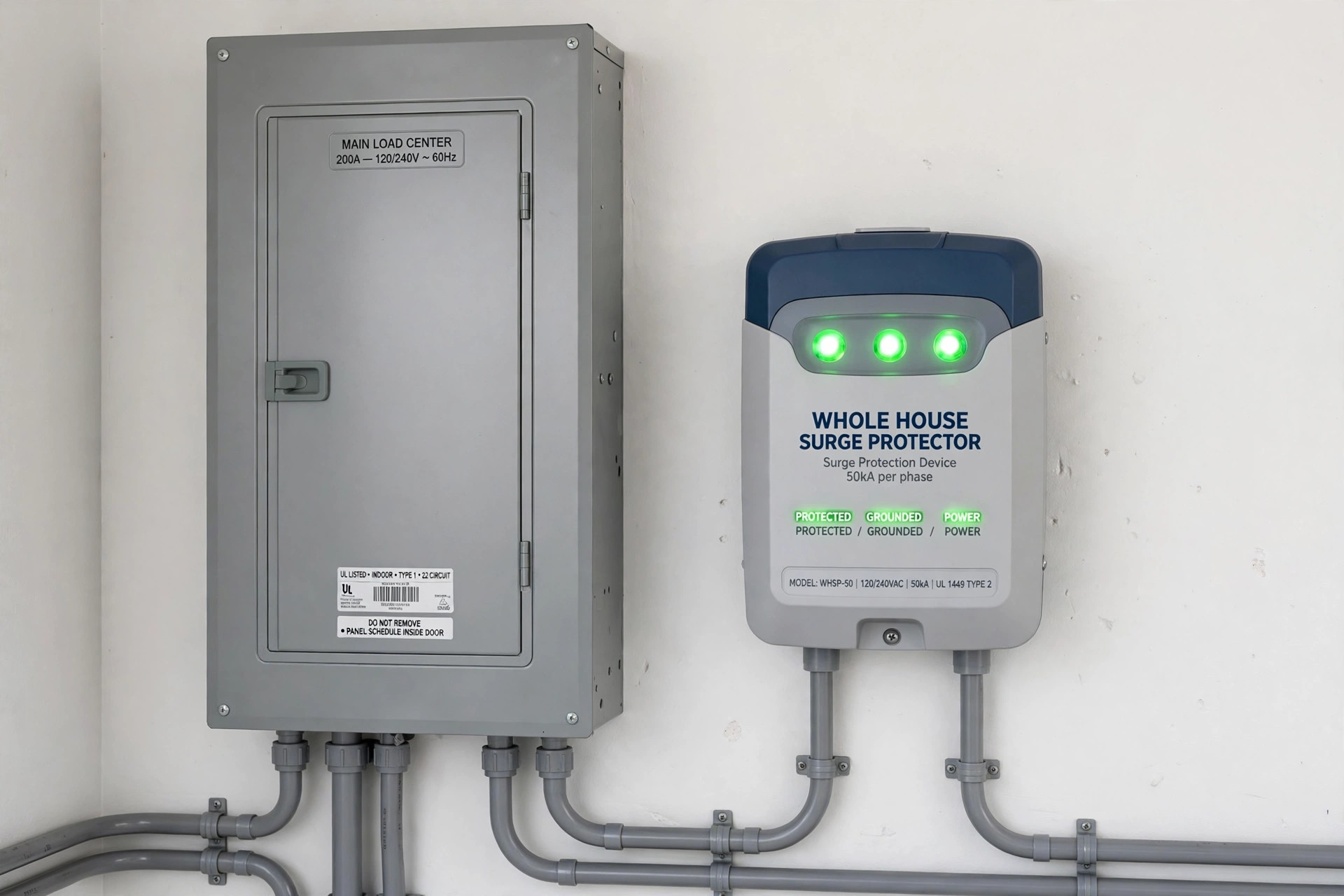
Florida is the lightning capital of the United States, and the surge that kills a home's electronics is rarely a direct strike on the roof — it is a nearby strike or a utility switching event sending a voltage spike down the service lines and into every circuit in the house. A whole-house surge protector, mounted at the main panel, shunts that energy to ground before it reaches the air handler, the refrigerator, the garage-door opener, and every device with a circuit board. This guide explains Type 1 vs. Type 2 devices, what surge-current ratings actually mean, why installation is electrician work, and the five protectors worth buying in 2026.
Last updated: October 27, 2026 · Prices and availability checked October 2026.
Florida Homebuyer HQ is reader-supported. When you buy through links on our site, we may earn an affiliate commission.
Compare the picks
| Product | Best for | Key spec | Price |
|---|---|---|---|
| Type 2 panel-mount surge protector (80kA class) | Most Florida single-family homes | Type 2 · ~80kA surge current · UL 1449 · status lights | Check price → |
| Type 1 surge protector (service-entrance class) | Rural, waterfront & high-exposure homes | Type 1 · service-entrance rated · highest surge capacity class | Check price → |
| Breaker-style surge protector (plug-on SPD breaker) | Homes with a compatible panel & spare slots | Fits a breaker slot · no separate enclosure · panel-brand specific | Check price → |
| High-capacity SPD (100kA+ class, commercial grade) | Large homes, home offices & high-value electronics | 100kA+ surge current · replaceable modules on some models · audible alarm options | Check price → |
| Budget Type 2 SPD under $100 | First whole-home protection on a budget | Type 2 · ~50kA class · UL 1449 · basic status light | Check price → |
Type 1 vs. Type 2, in plain terms
Type 1 devices install at the service entrance, ahead of the main disconnect, and are rated for the largest surges — the right first layer for high-exposure properties. Type 2 devices install at the main panel, on a dedicated breaker, and are the standard whole-home protector for most houses. Both are UL 1449 listed, both shunt surge energy to ground, and both are electrician-installed. The practical difference for a buyer is location and exposure: Type 2 for the typical home, Type 1 when the service entrance itself is the exposure point.
What the ratings mean — and which ones matter
Three numbers decide a device. Surge current rating (kA): the maximum surge current per mode the device is rated to handle — higher means more headroom and longer life under repeated surges, not invincibility against a direct strike. Voltage protection rating (VPR): the voltage the device lets through during a surge — lower is better, and it is the number that actually describes what your electronics experience. Modes of protection: a whole-home device should protect line-to-neutral, line-to-ground, and neutral-to-ground — all three, not just one. A device with a high kA rating but a poor VPR is marketing, not protection.
First: a surge protector is not a lightning rod, and panel work is not DIY
Two honest limits. A whole-home SPD reduces surge damage dramatically; it does not make a house lightning-proof, and no SPD replaces a lightning protection system (air terminals, down conductors, grounding) for a home that needs one. And every device in this guide wires into a live panel: the service lugs stay energized even with the main breaker off, which is why installation belongs to a licensed electrician. Budget for the visit alongside the device — it is the same visit for a $90 device and a $400 one, which is one more reason to buy the right device the first time. Before the electrician arrives, walk the house with the same source-first habit as our dehumidifiers guide: find what is actually at risk — the HVAC controls, the well pump, the gate opener — and protect the panel that feeds them.
How we compared them
We compared surge protectors on device type and installation path, surge current rating and voltage protection rating, modes of protection, UL 1449 listing, status indication (lights, alarms, replaceable modules), and panel compatibility — weighted toward Florida use: frequent nearby lightning, long overhead service runs in some areas, and homes full of board-driven appliances. An honest note: these are researched roundups built from manufacturer specifications and aggregated owner and electrician reviews, not surge-generator testing of every unit. No SPD guarantees protection against a direct strike; homes with that exposure should consult a lightning-protection professional.
The five whole-house surge protectors worth buying in 2026
Type 2 panel-mount surge protector (80kA class) Best overall
The default recommendation for a Florida house: a Type 2 surge protective device (SPD) mounted at the main panel, in the roughly 80kA surge-current class, UL 1449 listed, with status indicator lights. Florida leads the nation in lightning, and the surges that damage homes are rarely the direct strike — they are the nearby strikes and utility switching events that send thousands of volts down the service lines and into every circuit. A panel-mounted SPD shunts that energy to ground before it reaches the air handler, the refrigerator control board, the garage-door opener, and the entertainment system.
Installation is the part to get right: a Type 2 SPD wires into the main panel on a dedicated two-pole breaker, as close to the panel as the leads allow — short, straight leads matter, because every extra inch of wire adds impedance that weakens protection. This is licensed-electrician work, not a homeowner panel project: the panel stays live at the service lugs even with the main breaker off. Installed once, the device sits silently for years, its green lights confirming protection, until the day it sacrifices itself to a surge — which is exactly what it is for.
- Whole-home coverage from a single panel device; status lights show at a glance whether protection is live
- Panel work must be done by a licensed electrician; protects power lines only — see the layered pick below for cable/data
Best for: Most Florida single-family homes — whole-home coverage from a single panel device. Not ideal for: households whose needs are the opposite end of the rating range.
Type 1 surge protector (service-entrance class) Best for high-exposure homes
Homes at the end of long overhead service runs, on waterfront lots, or in areas that take frequent close strikes want the heavier class: Type 1 SPDs, rated for installation ahead of the main disconnect, at the service entrance itself. They are built to take the larger surge currents that reach a house before any panel device sees them, and they are the right first layer for properties where lightning is not an occasional event but a seasonal expectation.
Type 1 installation is utility-and-electrician territory — it touches the service entrance, and in many jurisdictions it requires coordination with the power company. For most suburban Florida homes on underground or short overhead services, the Type 2 pick above is sufficient and simpler; step up to Type 1 when exposure, a history of surge damage, or an electrician's assessment says the service entrance itself needs the protection. Pair either class with the portable power station plan in our hurricane guide: surge protection guards the equipment, backup power keeps it running.
- Highest surge capacity class — protection at the service entrance; right first layer for high-exposure properties
- Service-entrance work; utility coordination may be needed; overkill and extra cost for typical suburban services
Best for: Rural, waterfront & high-exposure homes — highest surge capacity class — protection at the service entrance. Not ideal for: households whose needs are the opposite end of the rating range.
Breaker-style surge protector (plug-on SPD breaker) Best easiest install
The simplest whole-home SPD to install is the one shaped like a breaker: it snaps into a spare slot in a compatible panel, wires like a breaker, and protects the whole panel from that position. For a homeowner whose panel is a common brand with open slots, this is the lowest-friction route to whole-home protection — one electrician visit, no separate enclosure on the wall, no extra conduit runs.
The constraints are compatibility and capacity: breaker SPDs only fit their maker's panels, they need two free slots (or a panel that accepts the configuration), and their surge-current ratings are typically lower than a dedicated Type 2 enclosure. Check your panel brand and spare slots before ordering anything — and if the panel is full, old, or a brand with known safety issues, the dedicated Type 2 enclosure above is the better buy, possibly alongside the panel conversation every Florida buyer should have with their inspector. Our moisture meters guide covers the other half of the Florida home-protection checklist.
- Simplest install — snaps into a breaker slot; no separate enclosure or extra wall space needed
- Panel-brand specific; needs spare slots; lower surge ratings than dedicated enclosures
Best for: Homes with a compatible panel & spare slots — simplest install — snaps into a breaker slot. Not ideal for: households whose needs are the opposite end of the rating range.
High-capacity SPD (100kA+ class, commercial grade) Best for large / high-value homes
Large homes with long branch circuits, dedicated home offices, and five figures of electronics want the heavier enclosure: 100kA-plus surge current ratings, sometimes with replaceable modules so a spent device is a module swap rather than a full replacement, and on some models an audible alarm that announces when protection is gone. The larger rating is not about surviving one enormous strike — it is about surviving many smaller surges over years without degrading, which is how most SPDs actually die.
Be clear-eyed about cost: this class runs several times the Type 2 pick, and it still needs the same electrician installation. Buy it when the value at risk justifies it — a home office full of workstations, a home theater, a smart-home system with dozens of connected devices — and when the house has already lost equipment to surges before. For a typical Florida home, the 80kA Type 2 pick is the right value; this class is the upgrade after a loss, not before one.
- Survives years of smaller surges without degrading; replaceable modules and alarms on the better models
- Highest cost here, plus the same electrician install; overkill for a typical home with modest electronics
Best for: Large homes, home offices & high-value electronics — survives years of smaller surges without degrading. Not ideal for: households whose needs are the opposite end of the rating range.
Budget Type 2 SPD under $100 Best budget
A budget Type 2 SPD is the right answer to the most common Florida homeowner objection: that whole-home protection sounds expensive. Under $100 for the device (plus the electrician visit, which is the same visit any SPD needs), a 50kA-class Type 2 unit gives a house real, panel-level protection against the everyday surges — utility switching, distant lightning, grid events — that quietly degrade electronics over years. It will not match the 80kA pick's longevity under repeated heavy surges, but it is vastly better than the power strip alone that most homes rely on.
Do not confuse this with a point-of-use strip: a budget panel SPD plus inexpensive point-of-use strips at the TV and computer is the layered system electricians actually recommend — the panel device takes the big energy, the strips take what is left. That pairing, for roughly the cost of one replaced television, is the best surge-protection value a Florida homeowner can buy.
- Real panel-level protection at the lowest device cost here; pairs with point-of-use strips for a proper layered system
- Lower surge rating — degrades faster under repeated heavy surges; basic status indication only on most models
Best for: First whole-home protection on a budget — real panel-level protection at the lowest device cost here. Not ideal for: households whose needs are the opposite end of the rating range.
Our verdict
Most Florida homeowners should buy the Type 2 panel-mount surge protector in the 80kA class, have a licensed electrician install it on a dedicated breaker with short leads, and check its status lights after every major storm — that single setup quietly prevents the most common Florida electronics losses. High-exposure homes should step up to the Type 1 service-entrance device; compatible panels with spare slots can take the breaker-style SPD; high-value electronics justify the 100kA class; and any budget should at least reach the budget Type 2 device paired with point-of-use strips. Add the layered habit — panel device plus strips at the TV and computer — and verify the rest of the home's storm readiness against our shutters vs. impact windows guide.
Frequently asked questions
Does a whole-house surge protector replace power strips?
No — it complements them. The panel device absorbs the large surge energy; point-of-use strips at sensitive equipment absorb the residual. Electricians recommend the layered system: panel protection first, strips second, never strips alone as the whole plan.
How do I know when a surge protector has failed?
By its status lights: most devices show green for protected and go dark (or red, depending on model) when the protective components are spent. Check the lights after any major storm or nearby strike, and replace a spent device promptly — an unprotected house looks exactly like a protected one until the next surge.
Will it protect against a direct lightning strike?
No SPD is rated to absorb a direct strike's full energy. Whole-home SPDs protect against the nearby strikes, induced surges, and utility events that cause the overwhelming majority of surge damage. Homes with direct-strike exposure need a full lightning protection system in addition, designed by a specialist.
Does it protect cable, phone, and data lines?
A panel SPD protects the power lines only. Surges also enter through cable, phone, and antenna lines; layered protection for those lines (coax/phone SPDs at their entry points) is a separate, inexpensive addition worth making for a home theater or home office.