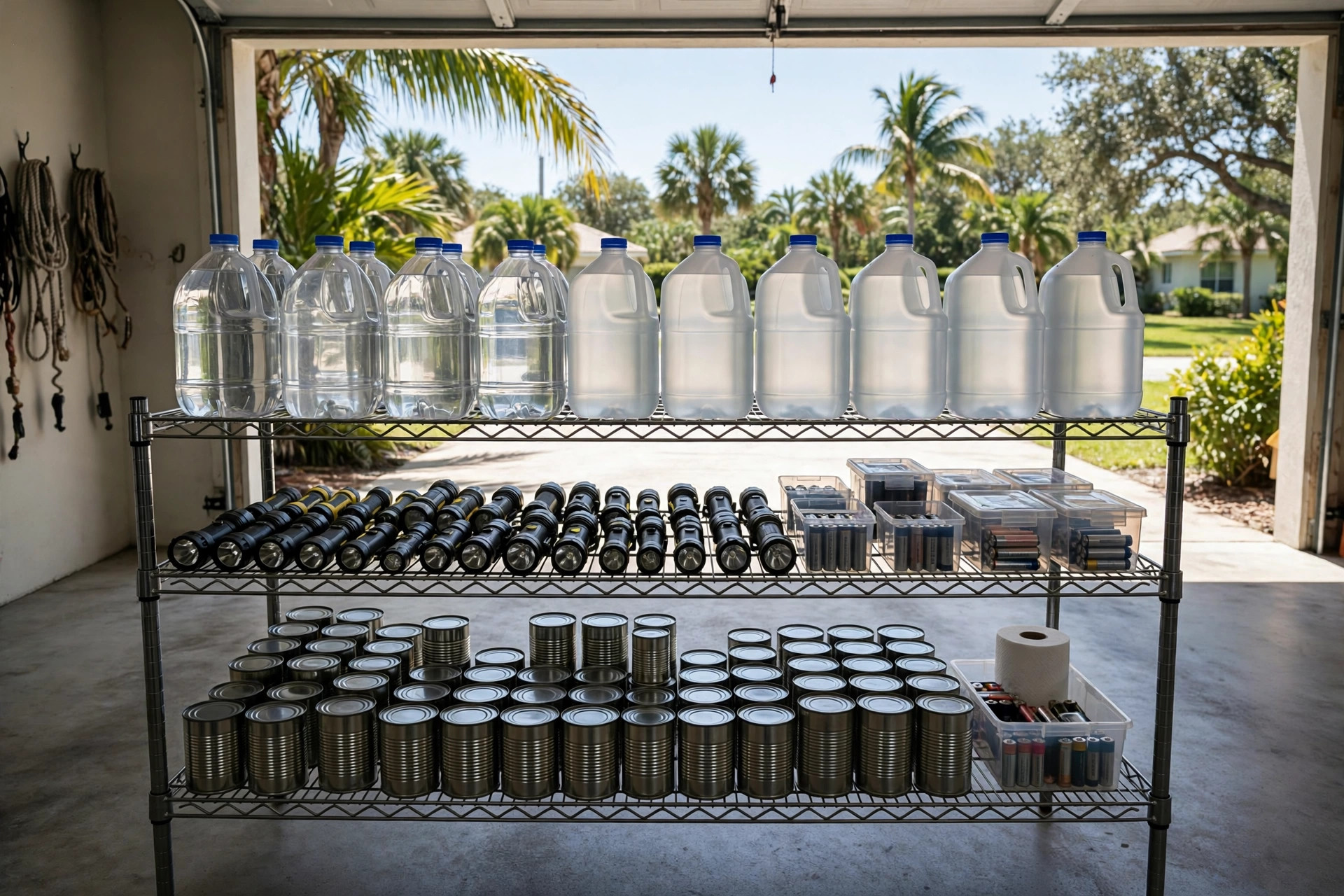
Every June, Florida buyers promise themselves they will build the kit this year. Every August, they are standing in a stripped grocery aisle at 9 PM under a tropical storm watch. Hurricane season runs June through November, power outages after a major storm routinely last days rather than hours, and the supplies that matter most are the ones that vanish from shelves first. This guide covers the four categories worth real money in 2026 — power, communication, lighting, and roof protection — what to look for in each, and the verdict on where your first dollar goes. For a pre-built option see our best hurricane emergency kits roundup, and for the full checklist see hurricane emergency supplies every Florida homeowner should own.
Last updated: October 7, 2026 · Prices and availability checked October 2026.
Florida Homebuyer HQ is reader-supported. When you buy through links on our site, we may earn an affiliate commission.
Compare the picks
| Product | Best for | Key spec | Price |
|---|---|---|---|
| Portable power station | Week-long outage resilience | 500Wh class; LiFePO4; solar input | Check price → |
| Hand-crank NOAA weather radio | Nighttime tornado warnings | SAME county alerts; crank + solar + USB | Check price → |
| Rechargeable LED lantern multi-pack | Whole-house safe lighting | Multi-pack; USB-C rechargeable | Check price → |
| Heavy-duty tarp with bungees | Post-storm roof damage | 12×16 ft minimum; 10-mil+ poly | Check price → |
Why these four, and why May — not August
Most hurricane supply lists run twenty items long and bury the signal. The four below are the categories where product choice actually changes outcomes: a power station that runs your fridge versus one that dies at hour six, a radio that works when the cell network does not, lanterns that light a room safely for a week, and a tarp that holds a damaged roof through the next rain band. Everything else on the classic list — water, food, batteries, cash, documents — is a commodity you buy, not a product you research.
Buy in May. Prices spike and shelves empty the moment a storm enters the Gulf, while Florida's disaster-supply sales-tax holiday typically lands in late May or early June — a real discount on exactly these categories. A kit assembled calmly in May costs less and works better than one panic-bought in August.
How we compared them
We compared product categories across the specs that matter in a real outage: usable capacity (not just the marketing number), runtime under realistic loads, how the product recharges when the grid is down for days, durability in heat and humidity, and price against the cost of the problem it solves. We weighted multi-day usefulness heavily — Florida outages after a major storm commonly run three to seven days — and we judged every pick for a household that may be sheltering in place with no generator.
An honest note: we did not buy and lab-test every product on the market. These are researched roundups built from manufacturer specifications, published runtime data, emergency-management guidance, and aggregated owner reviews. Every claim below is about what a category of product does and how to choose within it — not a promise that we personally tested your exact unit.
The four hurricane supplies worth owning in 2026
Portable power station (top pick) Best overall
The single most transformative hurricane supply of the last five years. A modern portable power station — a lithium battery with AC outlets, USB ports, and a solar input — silently runs a refrigerator for most of a day, recharges every phone in the house a dozen times over, powers a box fan through the night, and does it all without gasoline, fumes, or noise. For the Florida homeowner who cannot or will not run a gas generator, this is the centerpiece of the kit.
Shop by watt-hours and plan around the fridge. A 500Wh-class station covers phones, fans, lights, and a small medical device for a day or more; a full-size refrigerator needs 1,000Wh-plus or a disciplined rotation schedule. Choose LiFePO4 battery chemistry — it tolerates Florida garage heat and lasts thousands of cycles — plus a solar input to stretch runtime, and charge to full before every storm.
- silent, fume-free indoor power; runs fridge, fans, phones, and medical devices
- LiFePO4 models handle heat and last years; solar input extends runtime indefinitely
- real capacity costs real money — undersized stations disappoint at hour six
- heavy in the 1,000Wh class; recharge takes hours once depleted
Best for: running a refrigerator, fans, phones, and medical devices for days without a generator. Not ideal for: whole-house backup — that means a standby generator and an electrician.
 Portable Power Station 500W, 519.48Wh/140400mAh SolarCheck price on Amazon →
Hand-crank NOAA weather radio Best value
When the power fails and the cell network congests, the National Weather Service keeps broadcasting. A NOAA weather radio with SAME alert tones wakes you for tornado warnings in the middle of the night — the deadliest phase of a Florida hurricane landfall — and keeps you on official guidance when social media is rumor soup. The hand-crank and solar charging matter because this is the device you reach for when everything else is dead.
Buy one with all seven NOAA bands, SAME county-code programming (set it to your county so alerts are local, not statewide noise), a hand crank plus solar plus USB charging, and a built-in flashlight. The best models double as a small phone charger — a backup, not a replacement for the power station. Program the county code when you buy it, test the alert tone monthly during season, and store it where you will grab it at 2 AM.
- official alerts when cell networks fail; SAME programming keeps warnings local
- hand crank and solar mean it works with zero grid power; doubles as flashlight and phone top-up
- the hand crank is a trickle — plan on solar and USB as primary charging
- SAME setup takes ten minutes of reading the manual; do it in May, not during a watch
Best for: official warnings when the power fails and the cell network congests. Not ideal for: primary phone charging — it’s a backup charger, not a replacement for the power station.
 Solar Radio Emergency Hand Crank 12000mAh with Clear SignalCheck price on Amazon →
 Collapsible Portable LED Camping Lantern XTAUTO LightweightCheck price on Amazon →Rechargeable LED lantern multi-pack Best lighting
Candles are a fire department's least favorite hurricane tradition. LED lanterns put a room's worth of light on the table for days on a single charge, with none of the open flame risk in a house that may have gas appliances, stressed occupants, and no working smoke-detector batteries. Buy a multi-pack — one lantern per lived-in room plus the bathroom — because a single light source in a dark house gets old by night two.
Choose lanterns with multiple brightness modes (low mode can run a week or more), USB-C recharging so the power station tops them up, and a collapsible or hangable design. Avoid single-use battery lanterns as your primary — they work, but you will burn through your battery stockpile in three days.
- room-filling light with zero fire risk; low mode runs for days
- USB-C models recharge from the power station; multi-packs cover the whole house cheaply
- someone has to remember to charge them — set a pre-storm checklist
- cheap lanterns exaggerate lumen claims; read runtime specs, not brightness specs
Best for: putting a room’s worth of light on the table for days with zero fire risk. Not ideal for: buyers who won’t remember to charge them — set a pre-storm checklist.
Heavy-duty tarp with bungees Best roof protection
The blue-tarp roof is Florida's unofficial post-storm flag, and the difference between a tarp that holds and one that shreds is about twenty dollars. After a storm tears flashing, tiles, or shingles, the next rain band is often hours away — a heavy-duty tarp, correctly secured, is what keeps a roof problem from becoming an interior-water problem while you wait for a roofer who is booked six weeks out.
Buy at least 12x16 feet of 10-mil-plus polyethylene with reinforced corners and UV treatment, plus a bag of ball bungees and a staple gun with stainless staples. The technique: drape from the ridge over the damage, never nail through the field of the roof — secure to fascia and use 2x4 battens or sandbags at the edges so wind cannot work underneath. Practice once on a calm day in May; you do not want your first deployment on a wet roof in 40-mph gusts. One tarp per vulnerable roof section, stored dry with the bungees attached, ready to grab.
- stops a roof problem from becoming an interior-water catastrophe; cheap for what it protects
- ball bungees and battens make a secure install anyone can learn in one practice run
- thin tarps shred in the first follow-up storm — 10-mil minimum, no exceptions
- roof work after a storm is dangerous; hire it out if the damage is more than a small section
Best for: holding a damaged roof through the next rain band while you wait for a roofer. Not ideal for: large-scale roof damage — roof work after a storm is dangerous; hire it out.
 30 Pack Ball Bungee Cord, Heavy Duty Bungie Cord BallsCheck price on Amazon →
Our verdict
If you buy one thing, buy the portable power station — it is the only supply on this list that changes what a week without power feels like, and it earns its cost the first time the fridge stays cold. The NOAA weather radio is the cheapest life-safety device in the house; there is no excuse to skip it. LED lanterns are a May-afternoon purchase — buy the multi-pack, charge them, done. And the tarp kit is the supply you will be angriest about not owning if the storm finds your roof.
Honorable mentions: a first-aid kit, five-gallon water containers plus bottled water, a 20,000mAh battery bank, battery-powered fans for sleeping through a powerless August night, headlamps, and a waterproof document pouch for insurance papers and IDs. Commodities, not research projects — buy them on the same May trip.
Storing the kit so it works when it matters
A hurricane kit degrades silently in a Florida garage: heat kills batteries and humidity corrodes terminals. Twice a year — when you change the smoke-detector batteries — run the checklist: power station to 100%, lanterns charged, radio alert-tone test, tarp and bungees present and dry, first-aid kit in date, water rotated. Fifteen minutes, twice a year, is the difference between a kit and a pile of supplies.
Keep the kit in one clearly labeled bin where the whole household knows to find it. The best supply in the world helps nobody if it is buried behind the holiday decorations during a storm surge warning.
Frequently asked questions
Can a portable power station run my whole house?
No. It runs essentials — fridge, fans, phones, lights, small medical devices. Whole-house backup means a standby generator, which is a different budget and an electrician. Size the station for the fridge and comfort loads, not the air conditioner.
Is a hand-crank radio really better than my phone?
For official warnings, yes. NOAA broadcasts continue when cell networks congest or fail, and SAME alerts wake you at night. The phone is your news source; the radio is your warning system. Carry both.
When should I buy hurricane supplies?
May. Florida's disaster-supply sales-tax holiday typically falls in late May or early June, shelves are full, and prices are normal. Buying during a watch means paying more for less.
Do I need a generator instead of a power station?
Not necessarily. A gas generator runs more for longer but needs fuel storage, produces carbon monoxide, and cannot run indoors. For most households sheltering in place for three to seven days, a large power station plus a solar panel covers the essentials more safely and simply.