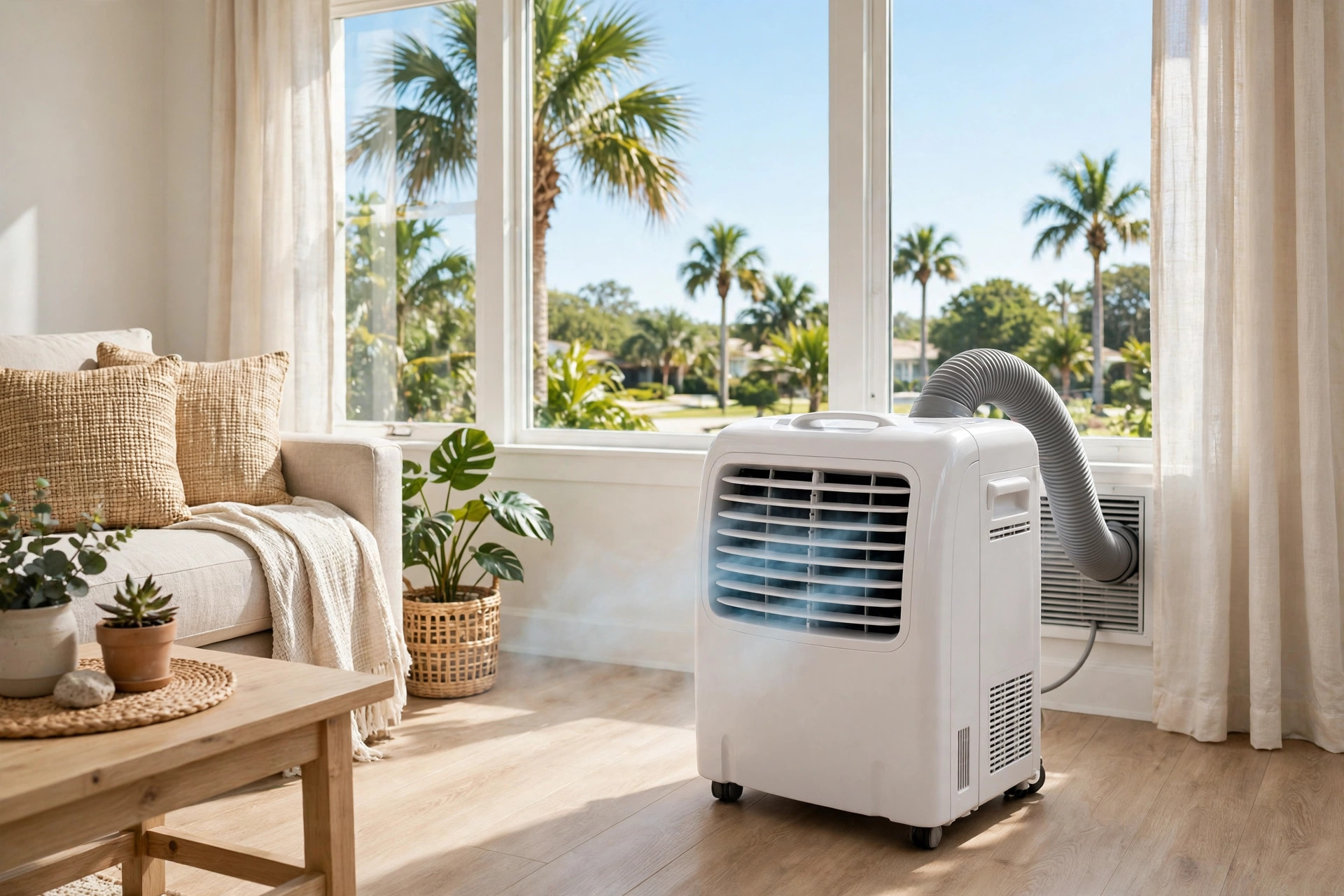
When central air falters, a room stays hot, or the power is out and the generator can only run one cooling load, a portable air conditioner is the fastest fix in a Florida home — if it is sized and vented right. The wrong one is too small for the room, exhausts its own cold air out the window, or fills its tank before noon. This guide explains BTU sizing for Florida heat, dual-hose vs. single-hose in humidity, the setup rules that decide whether the unit works at all, and the five portable air conditioners worth buying in 2026 — from a dual-hose 14,000 BTU all-rounder to a compact bedroom unit.
Last updated: November 10, 2026 · Prices and availability checked November 2026.
Florida Homebuyer HQ is reader-supported. When you buy through links on our site, we may earn an affiliate commission.
Compare the picks
| Product | Best for | Key spec | Price |
|---|---|---|---|
| Dual-hose portable AC (14,000 BTU) | Most Florida rooms | 14,000 BTU · dual hose · cools ~700 sq ft · dehumidifier mode | Check price → |
| Single-hose portable AC (12,000 BTU) | Bedrooms & medium rooms on a budget | 12,000 BTU · single hose · cools ~550 sq ft · sleep mode | Check price → |
| Portable AC with strong dehumidifier mode (12,000 BTU) | Humid Florida rooms & muggy nights | 12,000 BTU · high dehumidification · auto drain · ~550 sq ft | Check price → |
| Compact portable AC (8,000 BTU) | Bedrooms, offices & small rooms | 8,000 BTU · compact · quiet · cools ~350 sq ft | Check price → |
| Portable AC with heat pump (cool + heat) | Year-round cooling and heating | 14,000 BTU cooling · heat pump mode · smart wifi · ~700 sq ft | Check price → |
BTU sizing, in plain terms
BTU is cooling power: roughly 20 BTU per square foot is the baseline, so a 350-square-foot room wants about 7,000-8,000 BTU and a 700-square-foot room wants about 14,000. Florida adds a penalty on top of the chart: high ceilings, big west-facing windows, poor insulation, and a room over a hot garage all push the real load up, so round up a size when two or more of those apply. And note the rating type: since 2017 the honest number is the DOE-rated SACC BTU, not the older ASHRAE figure — a unit advertised at 14,000 ASHRAE BTU is often only about 10,000 SACC, and the SACC number is the one that predicts whether the room actually cools.
Single-hose vs. dual-hose, and why it matters in Florida humidity
Single-hose units exhaust hot air out the window and pull replacement air from the room — which means replacement air leaks back into the house from outside, hot and humid, undoing part of the cooling. Dual-hose units pull outside air in through a second hose to cool the condenser, so the room's cooled, dehumidified air stays in the room. In a dry climate the difference is modest; in Florida, where the incoming air is 90 degrees and wet, it is the single biggest efficiency factor in the purchase. Dual-hose costs more and needs a window kit with two ports, but for a room that runs all day in August, it pays for itself in comfort within the first summer.
First: the setup rules are not optional
Three rules, no exceptions. Vent the exhaust outside through a sealed window kit — venting into the room, the attic, or a gap around the kit defeats the unit entirely, and every extra foot of hose bleeds cooling, so keep the hose short and straight. Plan the drainage — portable ACs condense water out of Florida air constantly, and a unit without a continuous-drain hose will stop on a full tank, usually at 2 a.m.; run the drain hose to a sink or outside where the model allows it. Give it a real outlet — a 12,000-14,000 BTU unit draws serious current and wants a dedicated circuit, not a shared power strip with the television. A portable AC bought the week of a heat wave, vented through a cracked-open window, and plugged into a strip is worse than no portable AC at all — it runs, it rattles, and the room stays hot.
How we compared them
We compared portable air conditioners on SACC-rated BTU against real room sizes, single-hose vs. dual-hose design, dehumidification capacity in pints per hour, noise level at sleep settings, window-kit fit across window types, drainage options, and owner-reported reliability — especially whether the unit keeps cooling through a humid Florida afternoon or loses the room by evening. An honest note: these are researched roundups built from manufacturer specifications and aggregated owner reviews, not instrumented cooling tests of every unit. No portable air conditioner cools a whole house; a whole home needs central air or a multi-unit plan.
The five portable air conditioners worth buying in 2026
Dual-hose portable AC (14,000 BTU) Best overall
The default recommendation for a Florida home: a dual-hose portable air conditioner in the 14,000 BTU class. That size cools a large bedroom or living room through a Florida afternoon — roughly 700 square feet — and the dual-hose design is the reason it actually works in humidity: one hose pulls in outside air for the condenser while the other exhausts hot air, so the unit does not suck cooled, dehumidified room air out the window the way a single-hose unit does. In a state where the air outside is hot and wet, that difference is worth real money.
Size it by the room plus the Florida penalty: high ceilings, big west-facing windows, and poor insulation all push the real load above the square-footage chart, so a room the chart calls 500 square feet wants the 14,000 BTU unit, not the 10,000. And plan the venting before ordering — the window kit must fit your window type, and the hose should run short and straight, because every extra foot of hose bleeds cooling. Pair the cooling plan with the portable generator in our hurricane guide: a 14,000 BTU portable AC is one of the few cooling loads a mid-size generator can actually run during an outage.
- Cools a large Florida room through the afternoon heat; dual hose keeps humid outside air out of the cooled room
- Heavier and pricier than single-hose models; needs a window kit that fits your window type
Best for: Most Florida rooms — cools a large florida room through the afternoon heat. Not ideal for: households whose needs are the opposite end of the size range.
Single-hose portable AC (12,000 BTU) Best value
If the budget is the constraint, a single-hose 12,000 BTU unit is the value pick: it cools a bedroom or medium room well, costs noticeably less than a dual-hose unit of the same size, and is simpler to set up — one hose, one window kit, done. For a bedroom at night, when the outside air is cooler and the sun is off the windows, a single-hose unit performs far closer to its dual-hose sibling than the daytime numbers suggest, and the sleep mode keeps it quiet enough to actually sleep through.
Know the trade honestly: a single-hose unit exhausts room air out the window, and replacement air leaks back in from outside — hot, humid Florida air, which is exactly what you are trying to remove. In a leaky older home on a humid afternoon, that can cost a quarter of the cooling you paid for. Buy single-hose when the room is a bedroom, the use is mostly evenings, or the budget is fixed; buy dual-hose when the room faces west, the house is leaky, or the unit will run all day. Either way, seal the window kit well — a gap around the kit is a hole in your cooling.
- Real cooling at the lowest price for the size; simple setup — one hose, one window kit
- Pulls hot, humid air back in through house leaks; less efficient than dual-hose on humid afternoons
Best for: Bedrooms & medium rooms on a budget — real cooling at the lowest price for the size. Not ideal for: households whose needs are the opposite end of the size range.
Portable AC with strong dehumidifier mode (12,000 BTU) Best for humidity
Florida's problem is not just heat — it is humidity, and a room at 78 degrees and 70% humidity feels far worse than the same room at 78 degrees and 45%. A portable AC with a strong dehumidifier mode attacks the actual discomfort: it pulls pints of water out of the air per hour alongside cooling it, and on muggy nights the dehumidify-only mode can make a room comfortable without running the compressor at full blast. For ground-floor rooms, rooms over a crawl space, and homes where the central system leaves the air clammy, this is the pick that changes how the room feels.
Two practical notes: check the drainage. A dehumidifying unit fills its internal tank fast in Florida — look for a continuous-drain hose option and run it to a sink or outside, or you will be emptying the tank twice a day. And do not confuse this with a standalone dehumidifier: the AC cools as well, which is what you want in summer, but if the room is already cool and only damp, our dehumidifiers guide covers the dedicated machines that do the drying job better.
- Attacks Florida's real problem — humidity, not just heat; dehumidify-only mode for muggy nights without full cooling
- Tank fills fast in Florida — continuous drain is near-essential; not a substitute for a standalone dehumidifier in a cool damp room
Best for: Humid Florida rooms & muggy nights — attacks florida's real problem — humidity, not just heat. Not ideal for: households whose needs are the opposite end of the size range.
Compact portable AC (8,000 BTU) Best for small rooms
For a bedroom, a home office, or a small room that the central system never quite reaches, an 8,000 BTU compact unit is the right size: light enough to move between rooms, quiet enough for sleep and calls, and cheap enough to run without thinking about the electric bill. It is also the unit that fits the rooms where a big portable cannot — under a low window, beside a desk, in a room where the 14,000 BTU unit would be an obstruction as much as an appliance.
Do not oversell it: 8,000 BTU cools about 350 square feet on a good day, and a sun-blasted Florida room bigger than that will stay warm no matter how long the unit runs. Measure the room honestly, count the windows and the sun, and if the room is over 400 square feet, step up to the 12,000 BTU pick above rather than buying the compact unit twice. For the right room, though, the compact unit is the one that gets used every night — and a portable power station from our hurricane guide can even run a small fan off it during a brief outage, keeping air moving when the AC cannot run.
- Light, quiet, and cheap to run — the bedroom pick; fits rooms where a big unit cannot
- Only cools about 350 sq ft — too small for living rooms; struggles in sun-blasted rooms above its size
Best for: Bedrooms, offices & small rooms — light, quiet, and cheap to run — the bedroom pick. Not ideal for: households whose needs are the opposite end of the size range.
Portable AC with heat pump (cool + heat) Best for year-round use
Florida has cold snaps, and a portable AC with a heat-pump mode is the year-round answer: the same unit that cools a room in August heats it in January, far more efficiently than a space heater, without a second appliance to store. For a sunroom, a garage conversion, a rental, or any room the central system serves badly in both seasons, one unit doing both jobs is the practical buy — and the smart wifi control means the room is already comfortable when you walk in, rather than starting from a hot or cold box.
The cautions are the same as any portable AC, plus one: check the heating capacity honestly, because a heat pump's output drops as outside temperatures fall, and a Florida cold snap at 35 degrees is near the edge of what a portable heat pump does well. And check the circuit: a 14,000 BTU unit with heat wants a dedicated outlet, not a shared power strip — the same electrical care as our whole-house surge protector habit from the lightning guide, applied to the room that holds the unit.
- One unit cools in summer and heats in winter; heat-pump heating beats a space heater on efficiency
- Heating output drops in the coldest snaps; needs a dedicated outlet — not a shared power strip
Best for: Year-round cooling and heating — one unit cools in summer and heats in winter. Not ideal for: households whose needs are the opposite end of the size range.
Our verdict
Most Florida homeowners should buy the dual-hose portable air conditioner in the 14,000 BTU class, vent it through a sealed window kit with a short straight hose, run a continuous drain, and give it a dedicated outlet — that single setup quietly carries the hottest room in the house through August. Budget buyers should take the single-hose 12,000 BTU model for bedrooms and evenings; muggy rooms need the dehumidifier model; small rooms get the compact 8,000 BTU unit; and year-round rooms get the heat-pump combo. For outage cooling, pair the unit with the portable generator from our hurricane guide and the power station for fans and phones — cooling, power, and airflow together are the real Florida heat plan.
Frequently asked questions
What size portable AC do I need for a Florida room?
About 20 BTU per square foot as a baseline — 8,000 BTU for ~350 sq ft, 12,000 for ~550, 14,000 for ~700 — then round up a size for high ceilings, big west windows, or poor insulation. Use the SACC-rated BTU, not the older ASHRAE figure, which reads higher than the unit actually delivers.
Can a portable AC cool a whole house?
No. A portable AC cools one room, or one zone with doors closed. Whole-house cooling is central air's job; a portable unit is for the room the central system serves badly, a room without ductwork, or emergency cooling during an outage.
Do portable air conditioners need to drain water?
Yes, in Florida — they condense pints of water out of humid air every day. Most self-evaporate part of it through the exhaust, but in high humidity the tank still fills; use the continuous-drain hose where the model offers it, or expect to empty the tank regularly.
Can I run a portable AC on a generator during an outage?
Yes, with the right generator: a 14,000 BTU unit draws roughly 1,200-1,500 running watts, so a 3,500-watt inverter generator handles it alongside a refrigerator. Size the generator from our portable generator guide and run the AC on its own circuit — never through a shared strip.