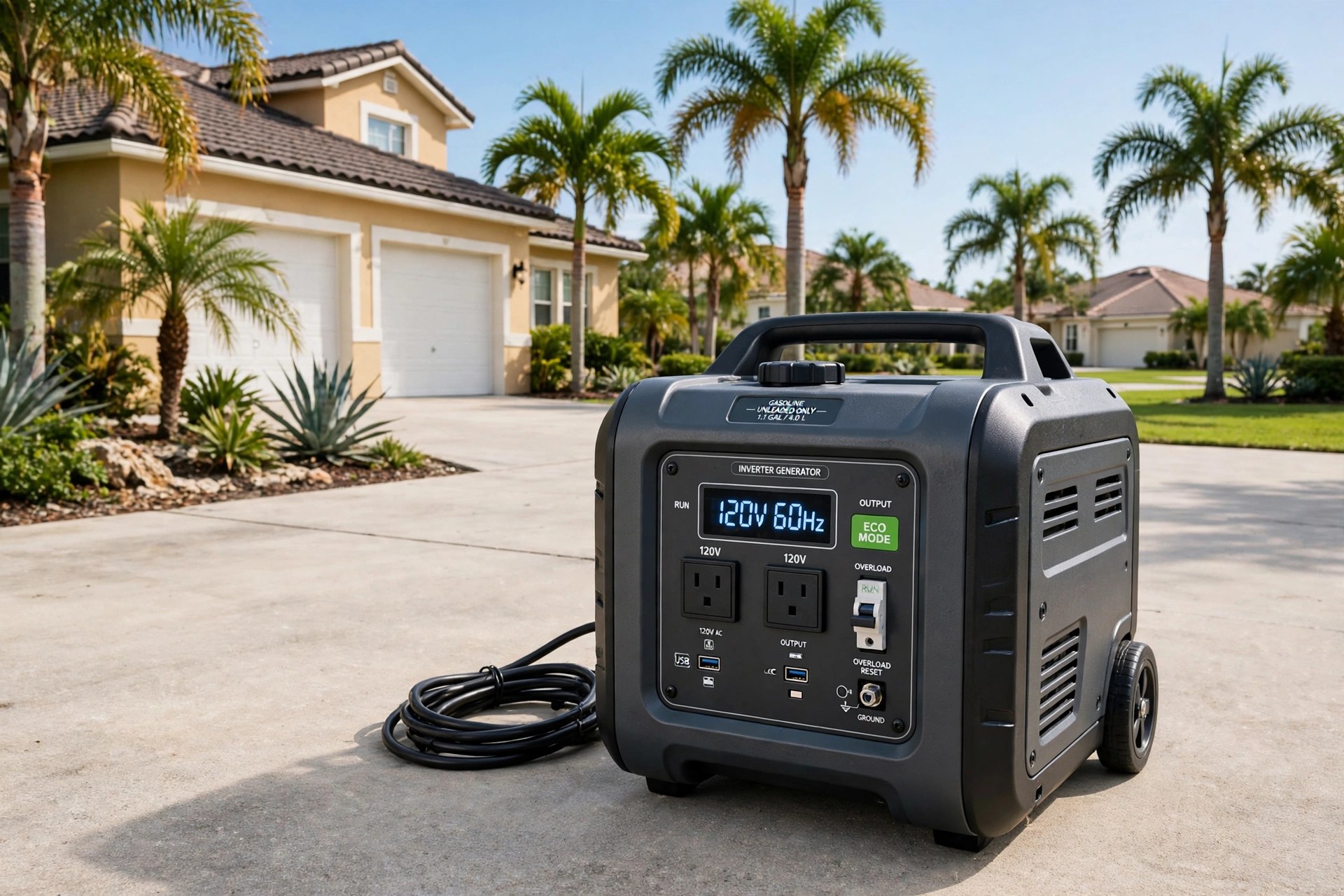
A Florida hurricane outage is not a camping trip: it is days without air conditioning in August heat, a refrigerator full of food on a clock, and — for well homes — no water at all. A portable generator is the difference between an outage you ride out and one that drives you out, but only if it is sized to your actual loads, fueled before the storm, and run safely outside. This guide explains running vs. starting watts, inverter vs. conventional power, dual-fuel flexibility, and the five generators worth buying in 2026 — from a quiet inverter all-rounder to a budget starter.
Last updated: November 3, 2026 · Prices and availability checked November 2026.
Florida Homebuyer HQ is reader-supported. When you buy through links on our site, we may earn an affiliate commission.
Compare the picks
| Product | Best for | Key spec | Price |
|---|---|---|---|
| Inverter generator (~3,500 running watts) | Most Florida single-family homes | ~3,500 running watts · inverter clean power · quiet · parallel capable | Check price → |
| Dual-fuel generator (gasoline + propane) | Long outages & fuel shortages | Runs on gasoline or propane · propane stores indefinitely · larger tank options | Check price → |
| Large portable generator (7,500+ running watts) | Large homes & well pumps | 7,500+ running watts · powers well pump & more circuits · transfer-switch ready | Check price → |
| Small inverter generator (~2,000 running watts) | Condos, apartments & light essentials | ~2,000 running watts · lightest class · very quiet · easy to store | Check price → |
| Budget conventional generator under $500 | First generator on a budget | Conventional (non-inverter) · ~3,500 watts · louder · lowest cost per watt | Check price → |
Running watts vs. starting watts, in plain terms
Running watts are what an appliance uses continuously; starting watts are the brief surge a motor-driven appliance — refrigerator, freezer, well pump, air conditioner — needs for a few seconds at startup, often double its running watts. A generator must cover running watts plus the largest single startup surge at the same time, or it trips the moment the fridge compressor kicks on. The practical method: list everything you must run together, add their running watts, add the largest startup surge, and buy above that total. Guessing this number is how generators get returned after the first outage.
Inverter vs. conventional, and why it matters for electronics
Inverter generators produce clean, stable power safe for phones, laptops, routers, and medical devices, and they throttle down at light loads, saving fuel and noise. Conventional generators produce rougher power that is fine for motors, lights, and heaters but risky for sensitive electronics, and they run at full speed regardless of load — louder and thirstier. If the generator will charge phones and run a router, inverter is worth the premium; if it will only run a fridge and fans, conventional power at a lower price is a fair trade.
First: the safety rules are not optional
Three rules, no exceptions. Outside only, 20 feet from the house, exhaust pointed away — never in a garage, carport, or under a covered porch, even with doors open. A battery carbon-monoxide alarm inside, tested before the season. Never backfeed through a dryer outlet or any improvised connection — it energizes the grid and endangers line workers; use extension cords to individual appliances or a professionally installed transfer switch. Fuel is the fourth rule: store stabilized gasoline safely, rotate it yearly, and keep a full propane tank if your generator is dual-fuel. A generator bought the week of the storm, fueled during the shortage, and run in the garage is worse than no generator at all.
How we compared them
We compared generators on running and starting watts, inverter vs. conventional output quality, fuel type and runtime per tank, noise level, weight and portability, parallel capability, and transfer-switch readiness — weighted toward Florida use: multi-day summer outages, well pumps, and heat. An honest note: these are researched roundups built from manufacturer specifications and aggregated owner reviews, not load-bank testing of every unit. No portable generator powers a whole central-air home; homes needing that should price a standby generator with an electrician.
The five portable generators worth buying in 2026
Inverter generator (~3,500 running watts) Best overall
The default recommendation for a Florida house: an inverter generator in the roughly 3,500-running-watt class. That size runs the essentials through a hurricane outage — refrigerator, freezer, fans, lights, phones, router, and a small window unit or portable air conditioner — without trying to power the whole house at once, and inverter power is clean enough for electronics, unlike a conventional generator's rougher output. It is also quiet enough to run overnight without becoming the neighborhood's least popular house.
Size it by starting watts, not running watts: a refrigerator needs roughly double its running watts for a few seconds at compressor startup, and that startup surge is what trips undersized generators. Add up the running watts of what you must run together, add the largest startup surge, and buy above that total — or run loads in shifts. Never run a generator in a garage or under a covered porch, even with the door open: carbon monoxide kills quietly, and every Florida storm season brings garage-generator deaths. Outside, 20 feet from the house, exhaust pointed away, with a battery carbon-monoxide alarm inside.
- Runs the outage essentials with clean, electronics-safe power; quiet enough for overnight use; parallel-capable for more power later
- Cannot run central air conditioning or an electric range; gasoline must be stored and rotated safely
Best for: Most Florida single-family homes — runs the outage essentials with clean, electronics-safe power. Not ideal for: households whose needs are the opposite end of the size range.
Dual-fuel generator (gasoline + propane) Best for fuel flexibility
The hurricane lesson every Florida homeowner learns once: gasoline runs out. Stations lose power, lines stretch for blocks, and the gas you stored in June is stale by September. A dual-fuel generator sidesteps the worst of it by running on propane as well — propane stores indefinitely, a 20-pound grill tank runs a mid-size generator for many hours, and propane is often available when gasoline is not, because fewer people are chasing it.
The trade is power: on propane a generator typically makes about 10% less power than on gasoline, so size one step up if propane will be your main fuel. Keep both fuels on hand before the storm — a full propane tank and stabilized gasoline, rotated yearly — and test the generator on both fuels before hurricane season, not during it. Pair the fuel plan with the portable power station in our hurricane guide for silent indoor power for phones and medical devices.
- Propane stores forever and is easier to find during shortages; two fuels means one shortage does not leave you dark
- Slightly less power on propane than on gasoline; propane tanks add storage and handling to plan for
Best for: Long outages & fuel shortages — propane stores forever and is easier to find during shortages. Not ideal for: households whose needs are the opposite end of the size range.
Large portable generator (7,500+ running watts) Best for large homes
Large homes, homes on well water, and homes with a septic pump need the bigger class: 7,500 running watts or more, enough to run a well pump's startup surge alongside the refrigerator and lights. A well pump is the load most buyers forget — without power, a well home has no water at all, not just no cold food — and its startup surge alone can exceed a small generator's entire capacity.
This class is heavy, loud, and thirsty, and it deserves a transfer switch installed by a licensed electrician rather than extension cords through windows: a transfer switch powers chosen house circuits safely and prevents backfeeding the grid, which endangers line workers. If your home has a well, a large generator plus a transfer switch is not a luxury — it is the water plan. Before the electrician arrives, walk the house with the same source-first habit as our dehumidifiers guide: list what must run, what can wait, and what shares a circuit.
- Powers well pumps and larger loads smaller generators cannot start; transfer-switch ready for safe whole-circuit backup
- Heavy, loud, and fuel-hungry compared with inverter models; transfer switch installation is electrician work with real cost
Best for: Large homes & well pumps — powers well pumps and larger loads smaller generators cannot start. Not ideal for: households whose needs are the opposite end of the size range.
Small inverter generator (~2,000 running watts) Best for condos & essentials
For a condo, a small home, or a household whose outage plan is 'keep the fridge cold and the phones charged,' a 2,000-running-watt inverter generator is the right size: light enough for one person to carry, quiet enough for close neighbors, and small enough to store in a closet between storms. It will run a refrigerator, fans, lights, and chargers — it will not run air conditioning or a microwave alongside the fridge, and that limit must be understood before the storm, not discovered during it.
Check your building's rules before buying: many Florida condos restrict generator use on balconies or in garages, and some prohibit them entirely — a generator you cannot legally run is an expensive paperweight. If your building allows outdoor ground-level use with the 20-foot rule, this class is the condo-friendly pick; if it does not, the battery power station is the fallback.
- Lightest, quietest class — easy to carry and store; right-sized for fridge, fans, lights, and chargers
- Cannot run air conditioning or large appliances; many condos restrict or prohibit generator use — check first
Best for: Condos, apartments & light essentials — lightest, quietest class — easy to carry and store. Not ideal for: households whose needs are the opposite end of the size range.
Budget conventional generator under $500 Best budget
A budget conventional generator is the right answer to the most common Florida homeowner objection: that backup power sounds expensive. Under $500 buys roughly 3,500 watts of real backup — enough for the fridge, fans, and lights — at the lowest cost per watt in this guide. The power is rougher than inverter output, so sensitive electronics should run through a power station or a quality surge protector, and the noise is genuinely louder, which matters with close neighbors.
Do not confuse cheap with careless: the same safety rules apply — outside only, 20 feet from the house, carbon-monoxide alarm inside, and never backfeeding through a dryer outlet. Paired with the whole-house surge protector habit from our lightning guide, a budget generator plus a power station for electronics is the best hurricane-power value a Florida homeowner can buy.
- Real backup power at the lowest cost per watt here; enough for fridge, fans, and lights through a multi-day outage
- Louder and rougher power than inverter models; sensitive electronics need a power station or surge protection
Best for: First generator on a budget — real backup power at the lowest cost per watt here. Not ideal for: households whose needs are the opposite end of the size range.
Our verdict
Most Florida homeowners should buy the inverter generator in the 3,500-running-watt class, fuel it before the season, test it twice a year, and run it outside 20 feet from the house — that single setup quietly carries a family through the most common multi-day outages. Fuel-shortage worriers should take the dual-fuel model; well homes need the 7,500-watt class with a transfer switch; condos and light loads get the small inverter; and any budget should at least reach the budget conventional generator paired with a power station for electronics. Verify the rest of the home's storm readiness against our shutters vs. impact windows guide — power, protection, and envelope together are the real hurricane plan.
Frequently asked questions
What size generator do I need for a refrigerator?
A typical refrigerator runs at 150-200 watts but needs 1,200-1,500 watts for a few seconds at compressor startup. A 2,000-running-watt generator handles a fridge plus fans and lights; a 3,500-watt class handles the fridge, freezer, and more together.
Can a portable generator run central air conditioning?
Almost never. Central air needs 3,500-5,000 running watts plus a startup surge that can exceed 10,000 watts — standby-generator territory. A portable generator runs a window unit or portable air conditioner, which is the realistic cooling plan for most homes.
How long will a generator run on a tank of gas?
At half load, most mid-size portables run 8-12 hours per tank; inverter models stretch further at light loads by throttling down. Plan fuel for the outage length, not the tank length — a three-day outage needs several tanks or a propane reserve.
Is it safe to run a generator in the rain?
Only under a generator tent or canopy that keeps rain off the unit while leaving all sides open for ventilation — never in a garage or enclosed porch. Wet electrical connections are a shock risk, and enclosed spaces are a carbon-monoxide risk; open-air cover is the only safe compromise.